TLDR
Not every tree problem is solved by pruning, and not every pruning job belongs in a homeowner’s hands. The clearest signs your trees need professional pruning include dead or hanging limbs, branches touching the roof or power lines, crossing and rubbing branches, storm damage, weak V-shaped unions, and water sprouts from previous bad cuts. Before removing live branches from a stressed tree, get a proper diagnosis of water, soil, pest, and disease factors first.
The Signs That Actually Matter
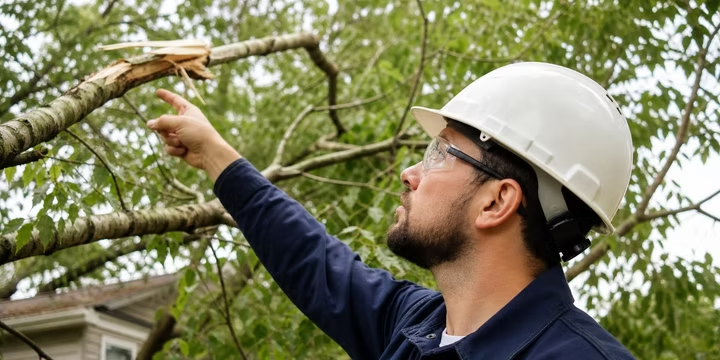
Your tree may need professional pruning if you see large dead or hanging branches, broken limbs, crossing or rubbing branches, limbs touching the roof or blocking clearance, water sprouts, storm damage, weak V-shaped unions, trunk cracks, or signs of disease or pests. Call a certified arborist immediately for large limbs, work above ground level, power-line proximity, sudden leaning, or major storm damage. Texas A&M Forest Service recommends that large-tree pruning and power-tool work be handled by a certified arborist.
That list probably looks familiar. Every tree-service website publishes something similar. What most of them skip is explaining what each sign actually means, whether pruning is the right fix, and when you should hold off on cuts entirely.
This guide works differently. It is organized as a glossary, so you can look up the exact symptom you see in your yard and understand what a professional would recommend, and why.
Not sure whether your situation calls for an arborist? Our certified arborist checklist walks through the decision step by step.
Quick Triage: Is This Urgent, Soon, or Wait?
Before you read the full glossary, use this table to figure out your next step.
Call a certified arborist now:
- Large broken or hanging limb, especially over a roof, driveway, or sidewalk
- Branches within 10 feet of high-voltage power lines
- Sudden lean in a tree that was previously upright
- Trunk split, major crack, or large open cavity
- Major storm damage with multiple broken limbs
Schedule professional pruning soon:
- Dead branches in the canopy, especially over targets
- Crossing or rubbing limbs that are growing larger
- Branches scraping your roof, gutters, or siding
- Low limbs blocking driveway, sidewalk, or sight lines
- Water sprouts or dense weak regrowth from previous cuts
- Overextended limbs with heavy end-weight
Diagnose before pruning:
- Sparse canopy, yellowing, or leaf scorch during growing season
- Dieback after drought
- Pest activity (exit holes, sawdust-like frass, webbing)
- Fungal growths on trunk or branches
- Root problems or soil concerns
Do not rush pruning:
- Tree looks dense but has no hazards or defects
- Tree is dormant (leafless in winter is normal for deciduous species)
- Oaks during February through June unless safety requires it
The rest of this article explains each of these situations, defines the professional terms you will encounter on estimates, and flags the red flags that separate good tree work from bad.
What “Professional Pruning” Actually Means
Professional pruning is not “making the tree smaller.” It is selective, objective-based cutting. Every cut should have a reason.
The tree care industry follows ANSI A300, the national pruning standard. Under that standard, recognized pruning objectives include managing risk, managing health, developing structure, providing clearance, managing size and shape, and improving aesthetics. Topping and lion’s tailing are explicitly flagged as unacceptable practices that can injure trees.
Texas A&M Forest Service puts it simply: each pruning cut is a wound, and incorrect pruning can harm trees and shorten their lives, while correct pruning helps trees stay healthy and maintain good structure.
A certified arborist should be able to explain the objective before the first cut: remove deadwood, reduce risk, improve structure, provide clearance, restore storm damage, or reduce a limb to a suitable lateral branch. If the only goal is “cut it way back,” that is a red flag.
A LinkedIn article by certified arborist Kristoffer Rasmussen makes the case that pruning should follow a written prescription defining the number of cuts, cut diameter, cut type, and which plant parts to remove. A good estimate should tell you what will be cut and why, not just say “trim tree.”
Glossary of Pruning Signs: What You See and What It Means
Deadwood (Dead Branches)
Plain meaning: Dead branches still attached to the tree.
What it looks like: Leafless limbs during the growing season, brittle or cracked wood, peeling or shedding bark. Snap a small twig: if it is dry and breaks cleanly instead of bending, it is likely dead.
Why it matters: Dead branches are one of the clearest signs your trees need professional pruning because they can fall without warning. Some interior deadwood is normal on mature trees, but large dead limbs over a roof, driveway, sidewalk, or play area are a different story.
The professional term for this work is “crown cleaning,” which the International Society of Arboriculture defines as removing dead, dying, diseased, weakly attached, and low-vigor branches from the crown.
When to call a pro: When deadwood is large, high, or over anything you care about. In Lubbock’s semi-arid climate, deadwood can follow drought, poor irrigation coverage, root stress, or disease. If you are seeing dead tips across the whole canopy, the tree may need diagnosis before aggressive pruning. Our guide to common tree diseases in West Texas covers several conditions that start with branch dieback.
Do not: Climb a ladder with a chainsaw to reach dead limbs overhead. That is professional territory.
Broken or Hanging Limbs
Plain meaning: A branch that has cracked, split, or snapped, or one that broke but is still lodged in the canopy.
What it looks like: A limb dangling from the tree, a branch resting on other branches, or a visibly cracked limb still partially attached.
Why it matters: This is an emergency sign. Texas A&M Forest Service says large broken or hanging limbs and overhead chainsaw work should be handled by an ISA certified arborist. They also warn people to stay away from dangerous hanging branches and downed utility lines.
If the limb is small and reachable from the ground, a homeowner with hand tools may be able to remove it safely. But anything large, high, touching the roof, or lodged overhead should not wait, and should not be a DIY project.
Do not: “Clean up” after a storm by topping the tree. Texas A&M warns that topping storm-damaged trees leaves stubs that grow weakly attached branches, reduces foliage needed for recovery, and can make recovery slower or less likely.
Crossing Branches
Plain meaning: Branches that grow across each other’s path. They may not touch yet, but they will interfere as they grow.
Why it matters: Crossing branches become rubbing branches. Iowa State Extension recommends removing crossing, rubbing, broken, diseased, and weak-angled branches during tree training.
Small crossing branches are easier and safer to correct early. Large crossing limbs may need a professional because removing a big limb creates a major wound, and Texas A&M says mature-tree pruning should be done for a good reason because each cut affects growth.
Rubbing Branches
Plain meaning: Branches that touch and grind against each other in wind.
What it looks like: Worn bark at the contact point, sometimes exposing lighter wood underneath.
Why it matters: Rubbing wears through bark and creates wounds. Those wounds become entry points for decay, insects, and disease. This is a small problem now that becomes a bigger problem later.
Practitioners on Reddit consistently list rubbing and crossing branches alongside dead, diseased, and damaged limbs as the first things they look for during a pruning inspection. Arborists sometimes call this starting with the “4 Ds” (dead, diseased, damaged, dysfunctional) and then checking for structural problems like rubbing.
A professional should decide which branch to keep based on structure, attachment angle, size, health, and future clearance.
Diseased Branches
Plain meaning: A branch showing signs of infection, such as cankers, sunken bark, abnormal discoloration, dieback, fungal growth, or unusual oozing.
Why it matters: Pruning can remove infected wood in some cases, but disease is not always solved by cutting. Some diseases require lab confirmation, chemical treatment, soil improvement, or irrigation correction. Texas Tree Surgeons correctly treats leaf discoloration, unusual growths, premature leaf drop, and fungal presence as reasons to get a certified arborist assessment, not just a quick trim.
This is a sign your tree needs professional pruning only if the diseased limbs can be isolated and removed correctly. If the issue is systemic, pruning alone will not fix it.
M&M’s arborists can conduct plant health diagnosis and send samples to the TAMU lab for confirmation. If you are noticing unusual leaf patterns or growth, interpreting tissue test results can clarify whether the problem is nutritional, pathological, or environmental.
Pest-Damaged Branches
Plain meaning: Branches with exit holes, sawdust-like frass, sticky residue, webbing, bark tunneling, or unusual woodpecker activity.
Why it matters: Pest damage weakens branches and may require targeted treatment beyond pruning. Pruning can remove the worst infested wood, but a professional should identify the insect and evaluate overall tree stress before deciding on a course of action. Not every pest issue requires spraying, and not every infested tree needs heavy pruning.
Sparse Canopy (Thinning Foliage)
Plain meaning: The tree has fewer leaves than expected, has bare patches, or one side is noticeably thinner during the growing season.
Why it matters: A thin canopy is a reason to call an arborist, not a reason to aggressively thin the tree. Removing more live foliage from a stressed tree makes the stress worse.
Texas A&M Forest Service explains that drought can kill fine feeder roots, leaving a tree unable to support a full canopy. In a place like Lubbock, which averages only 18.33 inches of annual precipitation, canopy thinning and dieback often trace back to water or soil stress rather than a need for more cuts.
This is where M&M’s dual capability matters. Uneven irrigation, overwatering, low pressure, compacted soil, or nutrient deficiencies can all show up as canopy symptoms. Sometimes a sprinkler system check reveals more about a tree’s decline than a canopy inspection alone.
Water Sprouts and Suckers
Plain meaning: Water sprouts are fast-growing vertical shoots on branches or the trunk. Suckers usually grow from the base or roots.
What it looks like: Clusters of thin, straight, rapidly growing shoots, often appearing after heavy pruning, topping, or stress.
Why it matters: A few sprouts may be a normal stress response. Many sprouts after a previous “trim” usually mean the tree was over-pruned or topped. Homeowners on Reddit frequently post photos of topped trees pushing masses of weak new shoots and ask whether this is normal. Practitioners consistently point out that this regrowth creates future maintenance and structural problems.
Removing every sprout at once is not always correct. An arborist may retain some temporarily or select better-placed shoots during restoration pruning.
Low Limbs and Clearance Problems
Plain meaning: Branches that interfere with people, vehicles, buildings, sidewalks, driveways, sight lines, lights, or fences.
What it looks like: You duck under branches to mow. Limbs block your driveway entry. Branches obscure security lights or street signs. Limbs interfere with sprinkler coverage.
Why it matters: ANSI A300 recognizes clearance as a pruning objective for traffic, infrastructure, sight lines, buildings, and regulatory compliance. The ISA calls this “raising,” which means removing lower branches to provide clearance.
A caution: raising too much at once can leave the tree top-heavy or remove too much live foliage. On young trees, lower temporary branches help trunk development. Iowa State Extension recommends maintaining live branches over at least 70% of the tree’s height during young-tree training.
Roof-Contact Branches
Plain meaning: Branches touching or resting on a roof, gutter, fascia, siding, or exterior wall.
Why it matters: Branches touching the roof during calm weather are worse in wind. In West Texas, where sustained wind is a constant, roof-contact limbs become abrasion tools that can strip shingles and damage siding over time.
Pruning should create clearance without topping or over-thinning the canopy. If someone solves roof contact by cutting the entire top flat, that is not professional pruning.
Branches Near Power Lines
Plain meaning: Any branch growing close to, touching, or capable of falling into overhead utility lines.
Why it matters: This is the most serious safety issue on the list.
The City of Lubbock FAQ states that under Texas Health & Safety Code Chapter 752, only professionals authorized by the local utility may prune or remove trees closer than 10 feet to high-voltage power lines. The same FAQ warns that high-voltage lines are not insulated, direct contact usually results in fatal electrocution, and a tree contacting a power line can become energized.
If a branch is near a power line, stop. Do not climb, use a ladder, use a pole saw, or hire an unauthorized crew. Call the utility or an authorized line-clearance professional.
Homeowners on Reddit frequently ask whether service-drop or power-line pruning is safe to DIY. The recurring practitioner answer is the same: call the utility or a qualified professional. Do not guess about insulation or voltage.
Sudden Lean
Plain meaning: A new or rapidly worsening angle in the trunk or whole tree.
Why it matters: A tree that has always grown at an angle may be stable. A sudden lean can indicate root failure, soil movement, internal decay, or structural instability.
Do not “balance prune” a suddenly leaning tree without evaluating roots and structure. If the lean points toward a house, street, driveway, or power line, escalate urgency. When a tree is beyond safe pruning, stump removal and treatment may become the necessary next step.
Trunk Cracks, Splits, and Open Wounds
Plain meaning: Visible cracks, vertical splits, open wounds, sunken bark, or separation where branches join the trunk.
Why it matters: These may indicate structural weakness, decay, storm damage, included bark, or disease. Pruning may reduce weight on a compromised limb, and cabling or bracing may help in some cases, but removal may be necessary if the defect is severe. Do not assume pruning will save a cracked tree.
Weak Branch Unions, Included Bark, and V-Shaped Forks
Plain meaning: A weak union is a branch attachment with poor structural strength. Included bark occurs when bark gets squeezed between stems instead of forming strong wood-to-wood attachment. V-shaped forks are often more concerning than wide U-shaped branch angles.
What it looks like: Homeowners often see “two trunks” and think the tree looks strong. Arborists see codominant stems, included bark, and potential failure.
Why it matters: Tight V-shaped forks with bark pinched inside can be the weak point where a tree comes apart in storms. Colorado State Extension notes that good branch unions are free of bark inclusions and that structural pruning develops branch structure less prone to failure.
Young trees can often be trained by subordinating one competing stem. Mature trees may need reduction pruning, cabling and bracing, or ongoing monitoring.
Overextended Limbs
Plain meaning: A long branch carrying too much weight far from the trunk.
Why it matters: Overextended limbs are more likely to break in wind, storms, or under ice loads. The correct response is reduction pruning, which shortens the branch back to a suitable lateral, not topping.
The ISA says reduction pruning should cut leaders and branch terminals back to secondary branches that are at least one-third the diameter of the cut stem. Texas A&M gives the same guidance. This is a strong line between professional pruning and hack work: proper reduction cuts to a suitable lateral, while improper cuts chop the branch randomly and leave a stub.
Pruning Terms You Will See on Estimates
When you get a tree-care estimate, you may see terms that are unfamiliar. Here is what they should mean.
Crown cleaning: Selective removal of dead, dying, diseased, weakly attached, or low-vigor branches. If your estimate says “crown clean,” it should mean removing specific problem branches, not stripping the inside of the tree bare.
Crown raising: Removing lower branches to provide clearance for people, vehicles, buildings, or sight lines.
Crown reduction: Decreasing the height or spread of a tree by cutting back to appropriate lateral branches, not to stubs. This is often the correct alternative to topping.
Branch collar: The swollen area where branch tissue meets trunk tissue. Proper removal cuts are made just outside the branch collar. A “clean cut” does not mean flush to the trunk.
Flush cut: A cut made too close to the trunk, into the branch collar. Texas A&M calls flush cuts improper because they can lead to internal decay and poor wound closure. They may look neat to a homeowner, but they damage the tree’s natural defense zone.
Stub cut: A cut that leaves too much branch sticking out. Iowa State Extension says branches should be removed back to their point of origin or to a side branch of sufficient size.
Three-cut method: The safe way to remove a large branch without tearing bark. An undercut first, a top cut farther out to drop the branch weight, then a final cut at the branch collar. This is one reason large-limb pruning is professional work: the sequence matters, and heavy branches can move unpredictably.
Topping: Cutting large branches back to stubs or weak laterals, usually to make a tree shorter fast. ANSI A300 flags this as an unacceptable practice. ISA’s own public messaging states that topping is indiscriminate cutting of large branches down to stubs, in contrast with science-based pruning that preserves natural form. If someone recommends “topping” a shade tree as routine maintenance, get a second opinion. Homeowners on Reddit often post after a tree has been topped and ask whether it is normal. Arborist responses consistently warn about weak regrowth, decay risk, and future maintenance costs.
Lion’s tailing: Over-thinning the interior of branches so foliage remains mostly at the tips, making limbs look like a lion’s tail. This is also flagged as unacceptable under ANSI A300. If the inside of your canopy is stripped bare and leaves are only at the ends, that is bad pruning. Reddit practitioners flag interior stripping and vague “thin interior sprouts” language on estimates as warning signs when not tied to a clear pruning objective.
Signs That Pruning May Not Be the Right First Step
Some symptoms look like pruning problems but originate somewhere else entirely. In West Texas, this is common.
Drought stress. Texas A&M Forest Service notes that drought can kill fine feeder roots, leaving trees unable to support a full canopy. A thin canopy or dead tips may point to water stress rather than a need for cuts. Pruning live tissue on a drought-stressed tree forces it to spend energy sealing wounds, energy it could otherwise use to overcome drought.
Overwatering or poor drainage. Standing water around roots can cause root stress, rot, and decline that mimics other problems. If you have standing water issues, fix drainage before blaming the canopy.
Soil compaction and nutrient deficiency. Poor soil conditions restrict root growth and starve the canopy. A TAMU lab soil or tissue test can identify specific deficiencies.
Root damage. Construction, trenching, or tree roots interacting with sprinkler lines can damage the root system and cause canopy symptoms that no amount of pruning will fix.
The tree is just dormant. A leafless deciduous tree in January is not dead. Do not pay someone to “clean it up” before you can evaluate it in spring.
A dense but healthy canopy. Texas A&M Forest Service says routine thinning does not always make trees healthier and that removing too much foliage can reduce growth and energy reserves. Do not prune just because a tree looks full.
The point: some signs mean “prune.” Some mean “inspect.” Some mean “treat.” Some mean “remove.” A professional visit should include diagnosis before cuts are made.
How Much Pruning Is Too Much?
Texas A&M Forest Service says not to remove more than 25% of a tree’s crown at one time. The ISA adds that mature trees often should have less removed.
More pruning is not better. If a mature tree needs major correction, it may need staged work over multiple seasons. Reddit arborist discussions frequently criticize jobs where 50% or more of the canopy was removed, and practitioners commonly repeat the 25% guideline.
If the finished tree looks like bare poles with leaves only at the tips, that is likely lion’s tailing or over-pruning, not professional work.
Texas Timing: When Should Trees Be Pruned?
Dead, diseased, and broken branches can often be removed whenever safety requires it. Heavy live-branch pruning on mature trees should be done for a clear reason and ideally not during high-stress periods.
The oak wilt exception. Texas A&M Forest Service recommends avoiding oak pruning or wounding from February through June because fresh wounds can attract beetles that spread oak wilt. Oak wilt has killed millions of trees across 76 Texas counties, and red oaks can die within a month of infection. All oak pruning wounds should be painted immediately, regardless of season. This is the one major exception to the general rule that wound dressing is unnecessary.
For non-oak species, wound dressing is not needed after proper pruning. Iowa State Extension notes that wound dressings do not speed wound sealing in most cases and may create a more favorable environment for decay organisms.
The drought exception. Do not heavily prune a drought-stressed tree to “help” it. Remove dead or hazardous branches as needed, but diagnose water and soil problems before removing live canopy.
Bad Pruning Red Flags: What to Watch For
Not every signs-your-trees-need-professional-pruning situation gets the right response. Bad pruning can be worse than no pruning. Here is what should raise concerns when hiring a tree crew.
Walk away if you hear:
- “We’ll top it.”
- “We’ll make it half as tall.”
- “We’ll clean out the whole inside.”
Ask these questions before hiring:
- Are you an ISA Certified Arborist, or is one supervising the crew?
- Do you follow ANSI A300 standards?
- What is the pruning objective for each tree?
- Will you top the tree? (The answer should be no.)
- How much live canopy will you remove?
- Are you insured?
- What happens if branches are near power lines?
A LinkedIn post aimed at property managers recommends asking these same questions, along with what pruning systems the company uses. This is not excessive. It is the minimum for protecting your trees and your property.
What a Professional Arborist Should Evaluate Before Pruning
A proper inspection includes more than looking at the canopy. Texas A&M recommends that risk assessments include the entire tree, not only visibly poor parts.
A thorough pre-pruning evaluation should cover:
- Tree species and age
- Overall health and condition
- Branch structure and attachment angles
- Dead, diseased, damaged, or dysfunctional wood
- Targets below (roof, driveway, sidewalk, play area, power lines)
- Wind exposure
- Root flare and soil condition
- Irrigation coverage and soil moisture
- Pest and disease symptoms
- Previous pruning damage (old topping cuts, flush cuts, stubs)
- Oak wilt timing considerations if the tree is an oak
- Power-line clearance requirements
In Lubbock and West Texas, points 8 and 9 matter more than they do in wetter climates. With only 18 inches of average annual rainfall, water management is inseparable from tree health. A company that can evaluate irrigation and tree health together will catch problems that a tree-only crew might miss.
Walk Your Yard: A Simple Homeowner Inspection
You do not need to be an arborist to spot the most obvious signs your trees need professional pruning. Take 10 minutes and walk your property.
- Look up for hanging limbs or large dead branches in the canopy.
- Look at the roofline for branches touching, resting on, or scraping shingles and gutters.
- Check clearance at driveways, sidewalks, and walkways.
- Look for branches rubbing each other, especially large limbs.
- Scan for deadwood throughout the crown.
- Examine trunk unions for tight V-forks, cracks, splits, or included bark.
- Look for pest or disease signs on bark and leaves.
- Check irrigation coverage and soil moisture near tree root zones. Dry spots, saturated areas, and low water pressure can all contribute to canopy stress.
If you see any of the urgent signs from the triage table, do not wait. If you see schedule-level issues, book an arborist consultation before the next storm season.
Pruning or Something Else? A Quick Reference
FAQ
What is the clearest sign my tree needs professional pruning?
Large dead, broken, hanging, or structurally weak limbs over a roof, driveway, sidewalk, or street are the strongest signs. If the work requires climbing, ladders, chainsaws, or power tools, Texas A&M Forest Service recommends hiring a certified arborist.
Can I prune dead branches myself?
Small dead branches reachable from the ground with hand tools may be manageable for some homeowners. Large dead limbs, high limbs, branches over people or property, and anything requiring a chainsaw should be handled by a professional.
How much of a tree can be pruned at once?
Texas A&M Forest Service says no more than 25% of the crown should be removed at one time. Mature trees often need less. If major correction is needed, it may take multiple sessions over several seasons.
Why is topping bad?
Topping is indiscriminate cutting of large branches to stubs. ANSI A300 flags it as an unacceptable practice that injures trees. It removes the tree’s food-producing foliage, triggers weak regrowth with poor attachment, opens large wounds to decay, and creates long-term maintenance problems. Crown reduction done correctly is the professional alternative.
Should I paint pruning cuts?
Usually no. The one important exception in Texas: paint all oak pruning cuts immediately, regardless of season, to reduce the risk of oak wilt. For other tree species, wound dressing is unnecessary after proper cuts and may even encourage decay.
Can I prune my oak trees in Texas?
Avoid non-essential oak pruning from February through June because of oak wilt beetle activity. If safety pruning is necessary during that window, use a qualified professional and paint all cuts immediately. Oak wilt has killed millions of trees across 76 Texas counties.
What if branches are near power lines in Lubbock?
Do not touch them. Under Texas law, only professionals authorized by the local utility may prune or remove trees within 10 feet of high-voltage power lines. Contact the utility or an authorized line-clearance crew.
Can pruning fix a diseased tree?
Sometimes pruning can slow disease spread by removing infected limbs, but disease is not always solved by cutting. Lab confirmation, chemical treatment, soil improvement, and irrigation correction may all be necessary. A certified arborist should diagnose the condition before deciding whether pruning is part of the solution.
When to Get Your Trees Inspected
If you are seeing dead limbs, storm damage, rubbing branches, roof clearance problems, or signs of tree stress in Lubbock or West Texas, have the tree inspected before making cuts. M&M Sprinkler and Tree Services has certified arborists on staff who can evaluate pruning needs alongside irrigation, soil health, and plant health factors, so you get a diagnosis, not just a trim.