
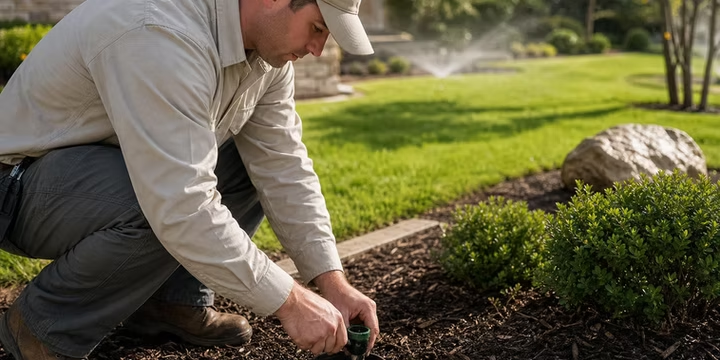
TL;DR: Automatic sprinkler system maintenance is the routine inspection, adjustment, cleaning, testing, and seasonal programming of a landscape irrigation system. It covers everything from sprinkler heads and valves to controller schedules, rain/freeze sensors, pressure, and backflow preventers. In Lubbock and West Texas, maintenance also means keeping your system compliant with local watering rules, including the 35°F irrigation cutoff and rain sensor requirements. A system that “turns on” is not the same as a system that works correctly.
A quick note: In this article, “automatic sprinkler system” refers to an automatic landscape irrigation system for lawns, beds, trees, and commercial landscapes. It does not refer to indoor fire sprinkler systems governed by NFPA codes. Search results for this phrase include both, so it is worth clearing that up right away.
What Does Automatic Sprinkler System Maintenance Actually Mean?
Automatic sprinkler system maintenance is the recurring work that keeps an irrigation system applying water where it belongs, at the right pressure, for the right duration, without leaks, runoff, overspray, or code violations. It is not a single task. It is a combination of mechanical checks, electronic testing, and programming adjustments done throughout the year.
Here is what it includes:
- Running each zone and watching for broken, tilted, sunken, or blocked heads
- Cleaning or replacing clogged nozzles
- Testing rain and freeze sensors
- Checking controller schedules, start times, runtimes, and seasonal adjustments
- Inspecting valves and solenoids for proper open/close function
- Evaluating pressure and spray coverage
- Looking for leaks, misting, soggy spots, dry patches, and pavement overspray
- Confirming backflow preventer condition and testing status
- Checking drip zones by walking beds, not just confirming the zone activates
- Reprogramming the controller for seasonal changes
The USU Extension irrigation checklist recommends examining systems carefully each spring and at least once a month during the growing season to keep them operating efficiently.
Wondering what a professional visit looks like in practice? Here is a walkthrough of what to expect during maintenance.
Maintenance Is Not Repair, and It Is Not Just “Turning It On”
Most homeowners blur the line between maintenance, repair, and inspection. They are related but different:
- Inspection means finding problems. You run zones and look for issues.
- Maintenance means preventing and correcting small issues through cleaning, adjustment, testing, and programming before they become failures.
- Repair means fixing something that has already broken: a cracked pipe, a dead solenoid, a shattered head, a failed controller.
- Audit means measuring performance with tools like catch cans to calculate how evenly water is being applied.
A practitioner on LinkedIn put it well: spring startup should be treated as the first full inspection of the season, not a quick turn-on. The post called out checking for pipe breaks, valve operation, and every sprinkler head before assuming the system is ready. That matches what extension services recommend, and it is a mindset more homeowners need.
Why the Word “Automatic” Changes Everything
A manual hose-end sprinkler only needs a person to move it and shut it off. An automatic sprinkler system depends on a controller, valves, solenoids, sensors, wiring, and programming. If the controller has duplicate start times, the rain sensor is set to bypass, or a solenoid fails, the system can waste thousands of gallons even when every sprinkler head looks fine.
According to the EPA, homes with clock-timer-controlled irrigation systems use about 50% more water outdoors than homes without irrigation systems. Waste increases when systems are programmed incorrectly, heads are aimed wrong, or leaks go unnoticed.
That is why automatic sprinkler system maintenance includes electronic and programming tasks, not just mechanical ones:
- Verifying the controller’s date, time, and active program
- Confirming only one start time per program unless intentionally using cycle/soak
- Checking whether the rain/freeze sensor bypass switch has been left on
- Testing station outputs to make sure each zone responds
- Reviewing seasonal adjustment percentages
- Checking Wi-Fi or weather-station connections on smart controllers
A Certified Landscape Irrigation Auditor noted on LinkedIn that simple walkthroughs and proper programming often solve many water-use problems, including correcting duplicate start times that homeowners did not realize were set.
Reddit discussions in r/lawncare and r/HomeImprovement confirm a common gap: many homeowners know their wall controller exists but have no idea where their zone valves are buried, how to manually operate them, or that the controller sends low-voltage signals to solenoids that open and close each valve. Understanding how solenoids work helps make sense of zone failures.
What Parts Get Maintained?
Every component in the system has a role in delivering water accurately. Here is what maintenance checks and why each one matters.
One insight that frequently surfaces in practitioner posts: worn, clogged, or incorrect nozzles can create uneven distribution without obvious signs. A Texas irrigation company on LinkedIn stressed that a real tune-up examines heads, nozzles, arcs, pressure, controller settings, and overall coverage, not just broken heads. Learn how to identify and clean clogged nozzles yourself between professional visits.
Why Automatic Sprinkler System Maintenance Matters
Water waste adds up fast
EPA experts estimate that 50% of outdoor water use can be wasted through evaporation, wind, or runoff from overwatering. A broken or damaged sprinkler setup can lose up to 25,000 gallons and $280 over a single six-month irrigation season. In a region where water costs real money and conservation is a community issue, those numbers are not abstract.
Replacing a standard clock-based controller with a WaterSense-labeled weather-based controller can save an average home nearly 7,600 gallons per year. Pressure-regulated spray bodies can save nearly 5,600 gallons per year when systems operate at or above 60 psi. But those savings only hold if the rest of the system is maintained.
Local compliance is real
In Lubbock, automatic irrigation system maintenance is not optional from a regulatory standpoint. The city prohibits irrigation when temperatures are below 35°F, during precipitation events, or with runoff onto sidewalks and roads. City of Lubbock code requires relevant automatic systems to include rain sensors set to shut off at 1/4 inch of moisture or more and freeze sensors that render the system inoperative at 35°F or higher.
In January 2026, Lubbock Code Enforcement issued a reminder that officers were watching for sprinklers running during subfreezing temperatures because runoff onto roads and sidewalks creates unsafe conditions and violates ordinances. Local Reddit threads in r/Lubbock show that residents notice and report neighbors watering during freezes, so enforcement is both official and social.
Small misses become big repairs
A clogged nozzle is a five-minute fix. A valve that does not seal properly is a moderate repair. But ignoring either one long enough can lead to dead turf, saturated foundations, pipe bursts from pressure imbalances, or a water bill that makes you question reality. Nationally, sprinkler repair costs average around $278, with backflow preventer replacements running $450 to $1,700 according to Angi’s 2026 data. Local quotes vary based on depth, access, roots, excavation, and system age, which is why practitioners on Reddit repeatedly caution homeowners against comparing flat rates.
Lubbock and West Texas: Why Maintenance Here Is Different
West Texas is harder on irrigation systems than most places. That is not a complaint; it is a maintenance reality.
Wind pushes spray off target. A head that covers perfectly on a calm morning misses by several feet on a windy afternoon. This makes nozzle selection, head spacing, and watering time of day more critical.
Dust clogs nozzles and filters. Blowing dirt is constant. Nozzle screens and drip filters need regular cleaning, or flow rates drop and dry spots appear.
Clay soil creates runoff. Texas A&M AgriLife research shows that 30% to 40% of irrigation water applied can be lost to runoff if a system runs too long on compacted or clay soils. The solution is cycle/soak programming, which splits a long runtime into shorter cycles with soak periods between them so water can infiltrate into the root zone instead of running off.
Freezes threaten exposed components. Lubbock nights can drop below freezing even in months you would not expect it. Exposed backflow preventers, above-ground piping, and unprotected valves are vulnerable. Maintenance means confirming your freeze sensor works and protecting exposed components before cold hits.
Watering rules change by season. Lubbock’s water conservation plan allows landscape irrigation twice weekly by address schedule, prohibits Sunday irrigation, and recommends a summer maximum of 1.5 inches per zone per week. Winter irrigation is limited to times above 35°F with lower amounts depending on turf type. That means your controller schedule should change at least four times a year.
How Often Should You Maintain Your Sprinkler System?
There is no single answer, but the consensus from extension services, the EPA, and field practitioners is clear: more often than most homeowners think.
Monthly during irrigation season: Run each zone for a few minutes and walk the yard. Look for obvious waste. This takes 20 to 30 minutes and catches problems early.
Spring startup: Treat this as the first full inspection, not just flipping the water back on. Check for winter damage, flush zones, test sensors, and set the spring schedule.
Mid-season check: By July in West Texas, heat, wind, and dust have had months to affect the system. Nozzles clog, heads get buried by mowing, and schedules set in April may no longer match plant needs. Adjust runtimes and clean or replace components.
Fall/winter prep: Reduce runtimes, test the freeze sensor, protect the backflow preventer, and confirm the controller will not water during a freeze.
Professional maintenance: At least annually. Ideally spring and fall, with a mid-season tune for West Texas properties.
For a deeper look at scheduling, read about how often sprinkler systems need service.
DIY Maintenance Checklist for Homeowners
You do not need a license to do basic monthly checks. Here is what to look for:
- Run each zone for 2 to 3 minutes and watch it operate
- Look for broken, tilted, buried, or blocked heads
- Watch for water hitting sidewalks, driveways, fences, or walls
- Check for mist or fog from spray heads (a sign of high pressure)
- Note dry spots and soggy spots
- Confirm the controller shows the correct date, time, and active program
- Verify the rain/freeze sensor is not set to bypass
- Open accessible valve boxes and look for standing water, insects, or debris
- Walk drip zone beds and check for dry plants or damaged tubing
- Compare your water bill to the same month last year
An irrigation contractor on LinkedIn made an important point about drip zones: seeing water come on does not prove a drip system is working correctly. Small flow changes, damaged tubing, pinched lines, or failing emitters can starve plant beds without the obvious visual cue of a broken spray head. Walk the beds. Touch the soil.
When to Call a Professional
Some maintenance tasks are beyond what a homeowner should attempt without training or tools. Call a sprinkler professional when:
- Multiple zones fail or skip
- A zone will not shut off
- Your water meter shows usage when nothing is running
- You suspect underground leaks
- Pressure problems affect several zones
- The controller needs replacement (Texas rules may require adding a rain/moisture shutoff device)
- Backflow preventer testing or repair is due
- Rain or freeze sensor compliance is uncertain
- You see major uneven coverage that head adjustments do not fix
Reddit’s r/Irrigation community repeatedly shows homeowners replacing heads when the real problem is a valve that is not sealing. One discussion explained that if heads leak while the system is completely off, changing the heads will not fix a bad valve diaphragm or debris stuck in the valve body. If you suspect valve trouble, a guide on valve and solenoid troubleshooting can help you identify the issue before scheduling a repair.
If the situation is urgent (a zone will not stop running, water is flooding your yard, or you have a mainline break), here is guidance on when to call a pro for sprinkler system failures.
Common Problems That Maintenance Prevents
This table connects what you see in the yard to what is likely happening and what maintenance action addresses it.
For underground leak situations, a guide to detecting hidden sprinkler leaks walks through the diagnostic steps.
Smart Technology Helps, But It Does Not Replace Maintenance
Weather-based controllers and flow monitoring are real upgrades. A smart controller can adjust schedules based on local weather data, and a flow sensor can flag abnormal water movement that suggests a break or a clog. The EPA supports weather-based controllers as water-saving devices that are independently certified for irrigation adequacy.
But smart technology has limits that are worth understanding.
Rachio community forum discussions reveal common misconceptions about flow monitoring. Some users expect flow sensors to detect all leaks at all times, but actual performance depends on sensor placement, zone calibration, threshold settings, whether non-irrigation water uses share the same line, and whether the controller checks flow only during scheduled runs or also while the system is idle. Default thresholds often need tuning. Drip zones, with their low flow rates, can fall near threshold limits and trigger false readings.
A smart controller cannot physically straighten a tilted head, clean a clogged nozzle, fix a valve diaphragm, or confirm that every drip emitter in a bed is actually delivering water. Flow monitoring is a maintenance upgrade, not a substitute for walking the yard.
For more on what flow monitoring can and cannot do, read about how flow monitoring detects hidden leaks and how it prevents catastrophic water loss.
Key Irrigation Terms Every Homeowner Should Know
Understanding these terms makes it easier to follow a technician’s recommendations, read a maintenance report, or troubleshoot basic problems yourself.
Backflow Prevention: A Maintenance Task You Cannot Skip
Backflow prevention protects your drinking water from potential contamination through the irrigation system’s cross-connection. TCEQ (Texas Commission on Environmental Quality) governs backflow prevention and provides official forms for assembly testing and maintenance reports.
Homeowners can visually check their backflow preventer for leaks, freeze damage, and physical condition. But actual testing and repair require qualified, licensed personnel. For a full walkthrough on caring for this component, read the backflow preventer maintenance guide specific to Lubbock requirements.
A System Can “Work” and Still Fail Your Landscape
This is worth stating plainly. A sprinkler system can turn on, run through every zone, and still water your yard poorly. Maintenance should look at plant response, soil infiltration, and root-zone needs, not just whether heads pop up.
If turf is browning in one zone while another stays wet, the system is not distributing water evenly. If trees on drip are declining despite the zone running on schedule, emitters may be clogged or the root zone may have expanded beyond the original emitter placement. If beds look fine on the surface but plants are stressed, overwatering or underwatering at the root zone could be the cause.
Sprinkler system maintenance is ultimately about plant health, water conservation, and compliance, not just mechanical function.
Frequently Asked Questions
Is automatic sprinkler system maintenance the same as sprinkler repair?
No. Maintenance prevents and finds problems. Repair fixes parts that have already failed, like a broken head, cracked pipe, bad valve, or dead controller. Regular maintenance reduces how often repairs are needed.
How often should I inspect my sprinkler system?
Monthly during irrigation season, plus a thorough spring startup and fall/freeze preparation. USU Extension recommends at least monthly checks during the growing season. Professional inspections should happen at least once a year.
Why do my sprinkler heads leak after the system turns off?
This is usually low-head drainage (gravity emptying the lateral pipe through the lowest head) or a valve that is not sealing properly. If the leaking stops within a few minutes, it is likely drainage. If it continues, the valve diaphragm may have debris or damage. Practitioners on Reddit’s r/Irrigation consistently point out that replacing the head will not fix a valve problem.
What does cycle/soak mean?
Cycle/soak is a programming method that splits a long watering runtime into shorter cycles with soak periods between them. Texas A&M research shows this reduces runoff and improves water infiltration, which is especially important on clay and compacted soils common across West Texas.
Do I need rain and freeze sensors in Lubbock?
Lubbock code requires relevant automatic irrigation systems to maintain rain sensors set to shut off at 1/4 inch of moisture or more and freeze sensors that shut irrigation off at 35°F or higher. The city also prohibits irrigation during precipitation events and below 35°F.
Can a smart controller replace sprinkler maintenance?
No. Smart controllers adjust scheduling based on weather, and that is genuinely useful. But they cannot fix broken heads, clean clogged nozzles, repair leaking valves, correct poor pressure, or verify that drip emitters are reaching every plant. Smart technology supports maintenance; it does not eliminate it.
What is the most commonly missed maintenance task?
Controller programming and sensor testing. Many systems run on autopilot with outdated schedules, duplicate start times, or bypassed sensors. These are invisible problems that waste water and can violate local rules without any visible sign of a broken part.
Should I be home during a sprinkler maintenance visit?
You do not have to be, since most work happens outside. But a practitioner on LinkedIn recommends walking the property with the technician to ask questions and understand your system. Even one walkthrough teaches you what to look for during your own monthly checks.
M&M Sprinklers serves Lubbock and West Texas with sprinkler repairs, maintenance checkups and plans, smart technology upgrades, certified backflow testing and repairs, and integrated tree and soil health services. If your system has not been checked this season, schedule a zone-by-zone inspection before small problems become expensive ones.